
We invite you to participate in a unique and thought-provoking two day program.
Theme | Program Summary | Program Agenda Day 1 | Program Agenda Day 2
The 9th Natural Resources Symposium program is divided into three principal focus areas: (1) US natural resource liability policy and practice; (2) emerging global natural resource practice synergies; and (3) natural resources in the broader context of key “game changers” (risk, energy, resource scarcity, biodiversity, etc.). Our program will continue to build upon the excellent and collaborative discussions of the Group’s two most recent Symposia -- the 2011 Symposium included collective discussions focused on building natural resource damage assessment and restoration “best practices” that could be used by diverse stakeholder groups to advance the fundamental goal of effective and appropriate resource restoration; and the 2009 Symposium explored how the use of an overall practice framework could aid resolution of natural resource liability claims, reduce transaction costs and expedite restoration and return resources to public use. The 2013 Symposium program will further the progress made at these prior Symposia by identifying ways to address specific natural resource liability issues in a holistic manner, benefitting the natural resources and area communities that use them, as well as allowing companies and governments to dispense of their respective responsibilities.
Day 1 of the Symposium will introduce the larger picture in which natura lresource issues reside today and will be comprised of two focus areas: (1) A Broader Context -- Focusing on Today's Game Changers and Implications for Natural resources Practices; and (2) Building on the Best of our Collective Experience -- Natural Resource Liabiliy and Restoration Policies and Practice. The first focus area will include an opening plenary segment introducing the four game changers to Symposium participants. The session will continue with presentations on several other initiativse and themes being seen globally that impact how natural resource issues are managed and addressed. The second focus area will begin with presentation and examination of several "drivers" that can help shape postiive natural resource liability, assessment and restoration practices and solutions and will focus on tools to shape a practice and be responsive to the game changesr and other influences now and into the future.
Day 2 of the Symposium will continue presentations and discussions on Building on the Best of our Collective Experience -- Natural Resource Liability and Restoration Policies and Practice; and introduce the third focus area of the Symposium: Facilitating Reasonable, Balanced and Predictable Natural Resource Practices -- Leveraging Global Synergies and Approaches. The program will begin with a real time look at current natural resource liability, assessment and restoration practices in the US, including the identification of tools, resources and actual case/site examples. The final program segment will include presentations and discussion of some of the synergies, similiarities and differences in natural resource liability, assessemnt and restoration practices worldwide and will conclude with a roundtable discussion among participants to identify specific examples as to who public and private sector parties can best address these issues.
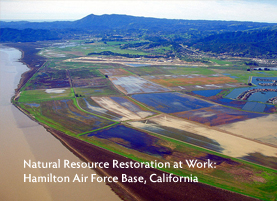
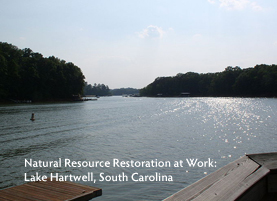
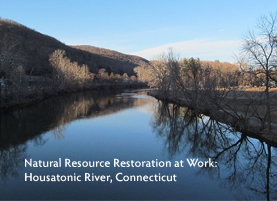
Increasingly, today, management of natural resource liability issues is heavily influenced by four game changers: economic efficiency, risk tradeoffs, energy exploration and biodiversity.
Independently and as a whole, the game changers described below can guide effective corporate strategies, government action, research initiatives and more.
Economic Efficiencies
Today’s challenging economic climate requires private and public sector entities alike to make difficult choices when it comes to competing demands. Further, parties have become more creative and pragmatic when it comes to making decisions about how to use available resources cost-effectively and efficiently. Relative to natural resource liability and optimization, there are strong incentives for private corporations, as well as government entities, to make sure that actions taken – whether it be mitigation, assessment and restoration of damages for lost services or general conservation initiatives – are proactive and well-managed to obtain maximum effect. At the 2013 Symposium, participants will hear about some of these challenges, innovative solutions and corresponding incentives to approaching natural resource matters in ways that strike a reasonable balance between costs and benefits.
Risk Trade Offs
Today, most decisions – whether by corporations or government agencies - are made in the context of a risk tradeoff paradigm. In the natural resource context, challenges can arise relative to setting priorities among public health and ecological risks and comparing different management options to address those risks. Parties also need to consider the inherent tradeoffs that exist when undertaking actions to optimize natural resource uses, while also minimizing potential risks and impacts to the environment. At the 2013 Symposium, participants will learn about the effects of risk assessment and management considerations on today’s natural resource policy and practice arenas, from the standpoint of industrial companies and government decisions-makers, as well as ways to leverage these influences in positive and productive ways.
Energy Exploration
The need for independent sources of energy has been a strong national initiative in the US, Europe and elsewhere and a particularly strong driver to the development of new energy resources, including arctic exploration, offshore oil and gas extraction and fracking. In the development of these energy resources and the emerging technologies to facilitate extraction, there are opportunities to constructively and proactively prevent, minimize and address effects on natural resources. At the 2013 Symposium, participants will learn how the policies and practices associated with energy exploration are developing real time, including opportunities and synergies with natural resource management, and how this could impact and influence the broader natural resource arena moving forward.
Biodiversity
As natural resource scarcity increases, the diversity and breadth of services provided by those resources decreases -- thereby raising the value and associated costs of those resources. In the natural resource liability and optimization context, conserving biodiversity does not only help to maintain and enhance the welfare of both human populations and ecological environments, but it also encourages economic stability in terms of availability and use of the natural resources. Further, preventing the loss of biodiversity has been an impetus and foundation of many environmental liability regimes worldwide. At the 2013 Symposium, participants will learn how to make decisions and undertake actions relative to natural resource liability and optimization issues in ways that conserve and/or enhance biodiversity, increase natural capital and help implement corporate and/or government environmental stewardship goals.